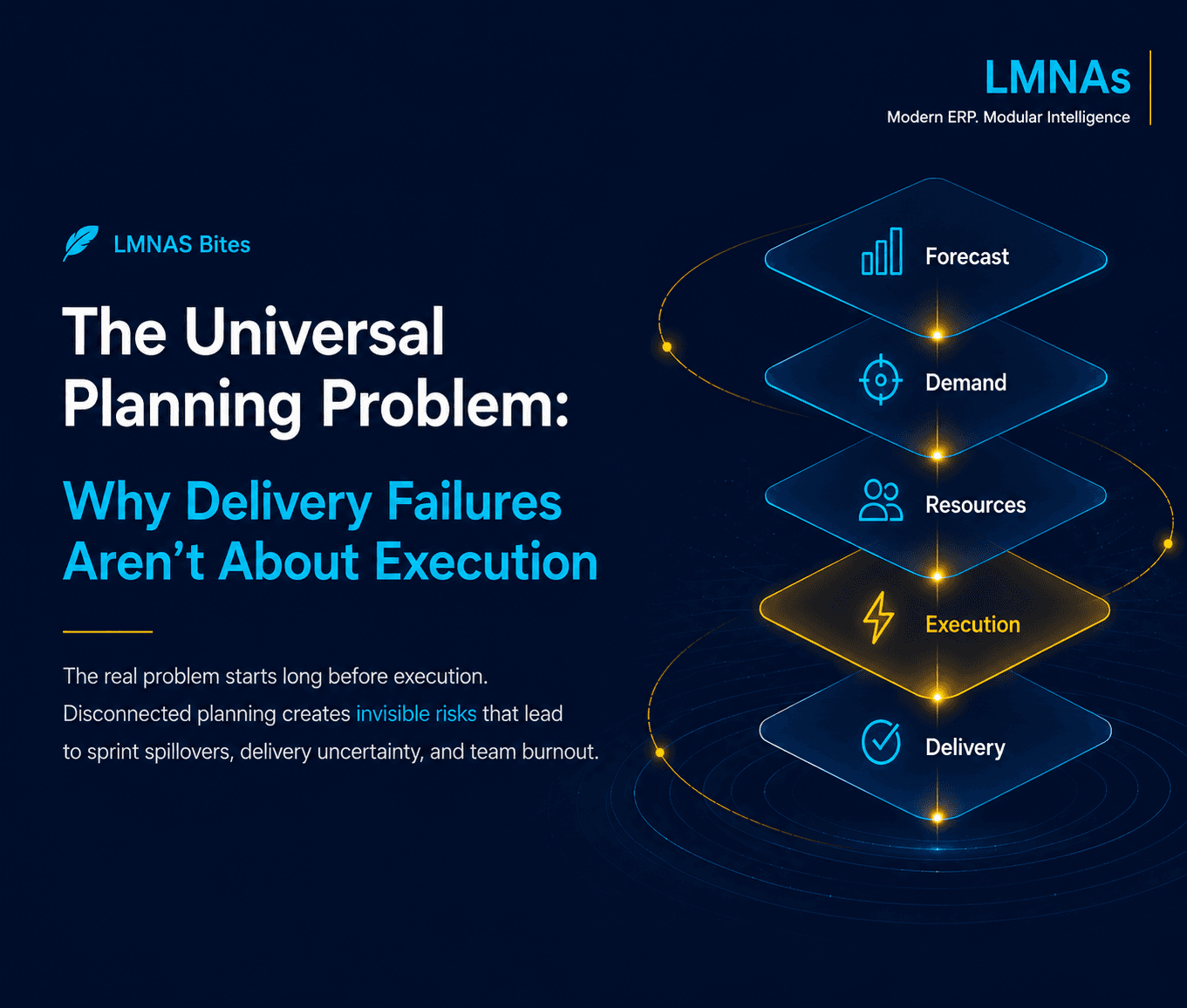
The Universal Planning Problem: Why Delivery Failures Aren't About Execution
Most leaders blame delivery failures on execution:
- Projects miss deadlines. Resources weren't allocated properly. Communication broke down.
- Production schedules slip. Procurement delays cascade. Shipments get delayed.
- Sprints fall apart. Capacity evaporates. Dependencies collapse.
These narratives dominate post-mortems and executive reviews across industries. But this diagnosis misses what truly matters: the seeds of execution failure are rarely planted during execution itself. They are sown during planning—sometimes months before work begins.
The symptoms appear when teams are deep in delivery. The root causes originated much earlier.
How Plans Become Fiction (In Any Industry)
Manufacturing Example
A production director forecasts Q3 demand. S&OP planning allocates capacity. Demand planning commits to procurement timelines. But by execution time, supplier delays, market shifts, and unplanned quality issues consume buffer capacity that was never accounted for.
IT and Agile Delivery Example
An IT leader forecasts quarterly capacity. Agile planning allocates team capacity across initiatives. Sprint planning commits to deliverables. But by execution time, production incidents, dependency delays, and unplanned compliance work consume capacity that was invisible to the plan.
The Core Problem Is Identical
A typical enterprise initiative begins with confidence—whether it's a manufacturing rollout or a software delivery.
Requirements are gathered. Capacity appears available. Resources are allocated. A plan is created. Commitments are made.
On day one, the plan looks realistic.
By day 90, it often looks like fiction.
Not because teams failed to execute, but because the plan was built on assumptions that reality couldn't sustain.
Resources that appeared available were shared across multiple initiatives. Dependencies slipped. Priorities changed. Capacity shrank as unplanned work—production issues, escalations, supplier delays, incidents—consumed time that was never accounted for.
Then execution began.
Teams managed their operations, committed to deliverables, tracked progress, and demonstrated completed work. At the execution level, everything seemed under control.
But outside that immediate execution window, reality was changing.
Critical issues emerged. Key resources became unavailable. External dependencies missed deadlines. Shared capacity was reallocated to higher-priority initiatives.
The execution plan remained intact.
The conditions required to achieve it did not.
What started as executing the plan gradually became protecting the plan. Teams replanned continuously, shifted resources, adjusted priorities, and worked harder to preserve commitments that no longer reflected reality.
Eventually, even strong execution could not compensate for weak planning assumptions.
Missed commitments, delivery uncertainty, and team burnout were not the cause of the problem. They were the outcome.
The real issue was that planning and execution had become disconnected.
The Five Stages of Planning: A Universal Framework
Every organization—regardless of industry—operates through five interconnected planning stages. Understanding this framework is essential to connecting planning with execution across the entire organization.
Stage 1: Forecast and Sales & Operations Planning (S&OP)
Planning begins with understanding future demand and aligning business objectives with operational capabilities.
In manufacturing, this involves market forecasts, customer demand projections, and production targets.
In IT, demand originates from business initiatives, product roadmaps, support commitments, customer requests, and operational priorities.
Where Disconnection Begins
Forecasts are often created using historical assumptions without considering real-time capacity constraints. As a result, organizations create expectations without understanding whether they can realistically deliver.
Stage 2: Demand Planning
Demand planning converts forecasts into actionable work.
In manufacturing, this means SKU-level demand and production requirements.
In IT, this translates into features, enhancements, projects, support requests, and sprint commitments.
Where Disconnection Grows
Demand is often planned without a complete understanding of available capacity, active dependencies, or delivery risks.
Stage 3: Resource Planning
Organizations then allocate the resources needed to fulfill demand.
In manufacturing, this includes materials, suppliers, labor, and equipment.
In IT, this includes team allocation, backlog refinement, vendor coordination, and dependency management.
Where Disconnection Becomes Risk
Plans assume resources will be available as expected. However, changing priorities, resource constraints, dependency delays, and unforeseen events frequently disrupt those assumptions.
Stage 4: Execution
Execution is where plans become reality.
In manufacturing, this includes production scheduling, quality control, and operational execution.
In IT, this includes sprint execution, development, testing, reviews, and deployment preparation.
Where Planning Assumptions Are Tested
Execution teams inherit assumptions made during earlier planning stages. At the same time, unplanned work emerges.
Manufacturing teams encounter quality issues, supplier delays, and operational disruptions.
IT teams encounter production incidents, critical defects, support escalations, and changing business priorities.
These activities consume capacity that was never reserved during planning.
Stage 5: Delivery and Monitoring
The final stage focuses on delivering outcomes and measuring performance.
In manufacturing, this includes shipment, logistics, fulfillment, and customer satisfaction.
In IT, this includes releases, deployments, production monitoring, and delivery reviews.
Where Organizations Discover the Consequences.
By this stage, the outcome is already determined. Monitoring reveals failures, but the underlying planning issues originated much earlier in the process.
Manufacturing and IT Follow the Same Planning Lifecycle
| Planning Stage | Manufacturing | IT Delivery |
|---|---|---|
| Forecasting | Market Demand | Business Initiatives |
| Demand Planning | SKU Demand | Features and Backlog |
| Resource Planning | Materials and Labor | Teams and Capacity |
| Execution | Production | Sprint Execution |
| Delivery | Shipment | Release and Deployment |
While the terminology differs, both environments depend on the same planning lifecycle and experience similar breakdowns when planning stages become disconnected.
The Reality Behind Agile Delivery
This universal planning challenge is not unique to manufacturing or waterfall projects. It affects Agile teams just as deeply.
Many IT teams claim to follow Agile practices, but achieving the true essence of Agile requires more than conducting sprint ceremonies and maintaining a backlog. It requires predictable planning, realistic forecasting, team accountability, and continuous adaptation.
Our team learned this through experience.
Despite following Scrum and sprint-based delivery, we frequently struggled to meet sprint commitments. Over time, retrospectives revealed a recurring pattern: The challenge was not execution alone. The challenge was planning and forecasting.
Several factors contributed to sprint setbacks:
- Unplanned leave and resource availability changes
- Limited team capacity during critical delivery periods
- Underestimation of task complexity
- Uneven workload distribution across team members
- Incomplete visibility into sprint progress and risks
- Inconsistent participation in sprint ceremonies and planning discussions
Individually, these challenges appeared manageable. Collectively, however, they reduced predictability and impacted our ability to consistently deliver sprint goals.
What became increasingly clear was that successful Agile execution depends on accurate planning and transparent visibility. Sprint ceremonies are effective only when they involve active participation from the entire team. Forecasts become reliable only when capacity, dependencies, risks, and historical performance are considered.
The transformation did not happen overnight.
There was no single process change that suddenly solved our planning challenges. Improvement came through a series of deliberate adjustments, including refining estimation practices, improving sprint visibility, balancing workloads more effectively, and continuously learning from each sprint cycle.
These gradual improvements increased our confidence in planning and forecasting. More importantly, they exposed a broader truth: the planning challenges facing our IT organization were not unique. They were universal.
The Business Impact of Unpredictable Delivery
The consequences of disconnected planning extend far beyond missed sprint goals.
As sprint commitments became increasingly difficult to predict, tasks frequently spilled over into subsequent sprints. What initially appeared to be isolated planning challenges gradually created a ripple effect across delivery timelines, team morale, stakeholder confidence, and business outcomes.
Recurring Sprint Spillovers
Incomplete work carried forward from one sprint to the next, making future planning increasingly difficult. This reduced the team's ability to accurately forecast delivery timelines and maintain predictable release schedules.
Increased Team Pressure
As deadlines approached, teams often found themselves working under significant pressure to recover lost time. Last-minute efforts and extended working hours became more common, increasing the risk of fatigue and burnout.
Reduced Focus on Quality
When delivery timelines become compressed, quality-related activities are often the first to be affected. Testing, documentation, code reviews, and other engineering hygiene practices may receive less attention, increasing the likelihood of defects and technical debt.
Last-Minute Delivery Rushes
Work that should have been distributed consistently throughout the sprint frequently accumulated toward the end. This created unnecessary execution risk and reduced opportunities for proactive issue resolution.
Declining Stakeholder Confidence
Predictability is a critical component of trust. Repeated delays and changing delivery expectations can reduce confidence among stakeholders and business teams, making future commitments more difficult to communicate and defend.
Impact on Customer Relationships
Delayed delivery timelines can influence customer perception and confidence. In some cases, customers may become hesitant to invest further in enhancements, change requests, or future initiatives until delivery stability is demonstrated.
Reduced Return on Investment
Inefficient planning and execution can result in underutilized resources, delayed value realization, and increased operational overhead. Over time, these factors reduce the overall return on investment from delivery efforts.
Ultimately, the challenge was not simply about missing sprint targets. It was about the broader impact on delivery predictability, product quality, team sustainability, customer trust, and business outcomes.
What We Learned About Planning
Through multiple sprint cycles, we realized that delivery challenges were not caused by a lack of effort or commitment from the team. The underlying issue was the gap between planning assumptions and execution reality.
To improve predictability, we focused on several key principles:
- Capacity before commitment
- Prioritization driven by business value
- Ownership-based planning
- Commitment through planning discipline
- Continuous visibility throughout execution
- Data-driven decision making
- Continuous improvement over perfection
These principles became the foundation for our approach to delivery management and planning.
How Connected Planning Works in IT Delivery
Understanding the problem was only the beginning.
The real challenge was keeping all planning stages connected throughout execution. This is where LENS IPS became a critical part of our delivery process.
Step 1: Understand Capacity Before Planning
Every sprint begins with a simple question: What can the team realistically deliver?
Before any commitment is made, LENS IPS provides visibility into:
- Available resources for the sprint and each member's unavailability (planned leave, other commitments)
- Individual delivery capacity (how many stories can each team member realistically complete)
- Total team capacity using the Compute Velocity module—which calculates realistic capacity based on actual historical performance, not guesses or optimistic assumptions
- Clear picture of planning constraints including priority, effort estimation, and dependencies
Instead of relying on assumptions, planning starts with a clear understanding of what the team can genuinely deliver. This is capacity-driven planning—not hope-driven planning.
Step 2: Build Commitments Based on Reality
Once capacity is understood, planning decisions become more objective.
Teams evaluate:
- Business priorities
- Story estimates
- Available capacity (real, not theoretical)
- Existing commitments
- Delivery constraints
This ensures that sprint commitments are aligned with both business needs and execution capability.
Step 3: Create Ownership Through Plan My Story
Planning is most effective when the people doing the work actively participate in creating the plan.
This is where the Plan My Story module changes everything.
Instead of managers assigning work top-down, individual team members pick the stories they can realistically plan and schedule based on:
- Their personal availability
- Priority
- Effort estimation
- Their own capacity understanding
LENS IPS generates the entire sprint schedule automatically—showing each member exactly what they're committing to and when. This creates genuine ownership, not compliance. And it's faster than traditional planning meetings because the system removes the guesswork.
The result: Clarity of task with priority, and team members who are accountable because they chose their own commitments.
Step 4: Lock the Sprint Commitment
After Plan My Story, team members break stories into concrete executable tasks. Each task is owned and locked by its individual task owner—meaning the sprint commitment is now fixed and measurable.
No vague backlogs. No scope creep. No "we'll figure it out during execution." Everyone knows exactly what they promised, and it's locked in the system.
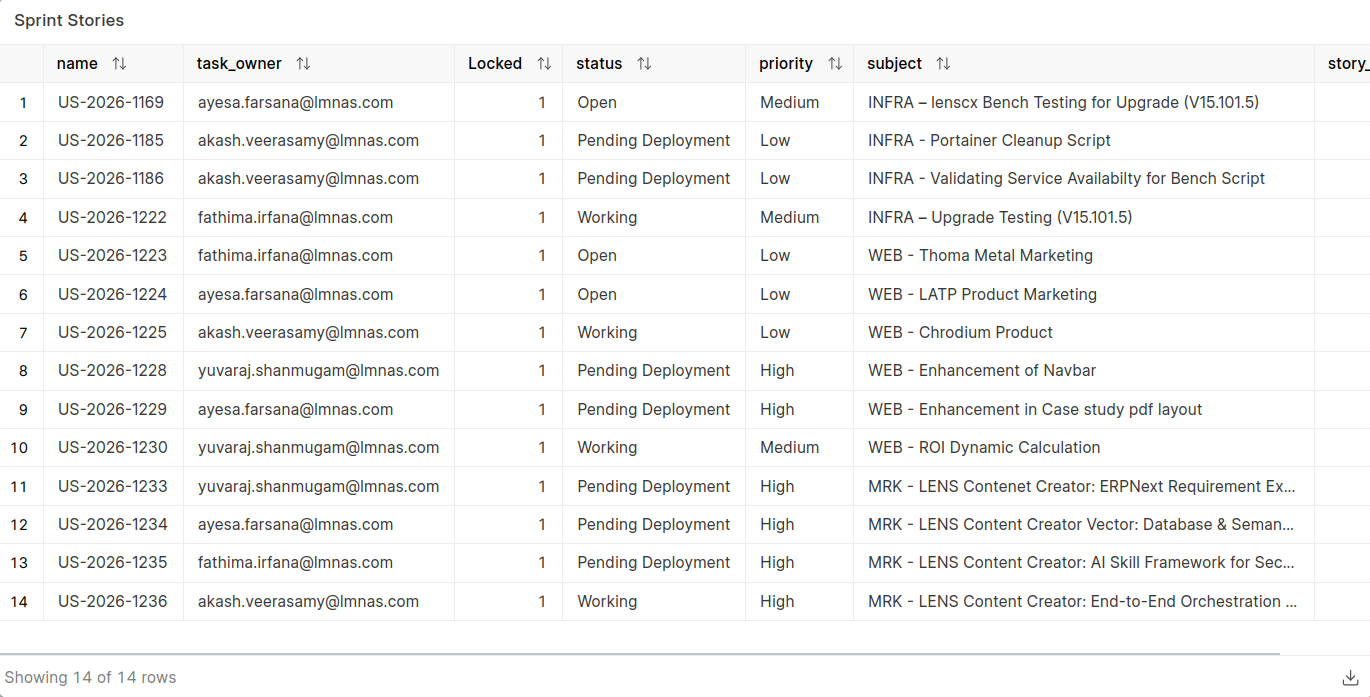
At this point, the sprint moves from planning to execution with clarity and accountability.
Step 5: Execute With Daily Visibility
Many organizations only discover problems when a sprint is already at risk.
To avoid this, daily huddles are supported by LENS IPS execution dashboards that provide real-time visibility into:
- Actual state: What stories and tasks were completed today
- Ideal state: What should have been completed to stay on track
- Immediate deviations: Where the sprint is drifting
- Sprint health indicators: Team performance, delivery trends, risk signals
This immediate comparison surfaces deviations before the sprint is at risk. Teams identify blockers and adjust mitigation plans same-day instead of discovering problems in week 2 or waiting for retrospectives to reveal damage.
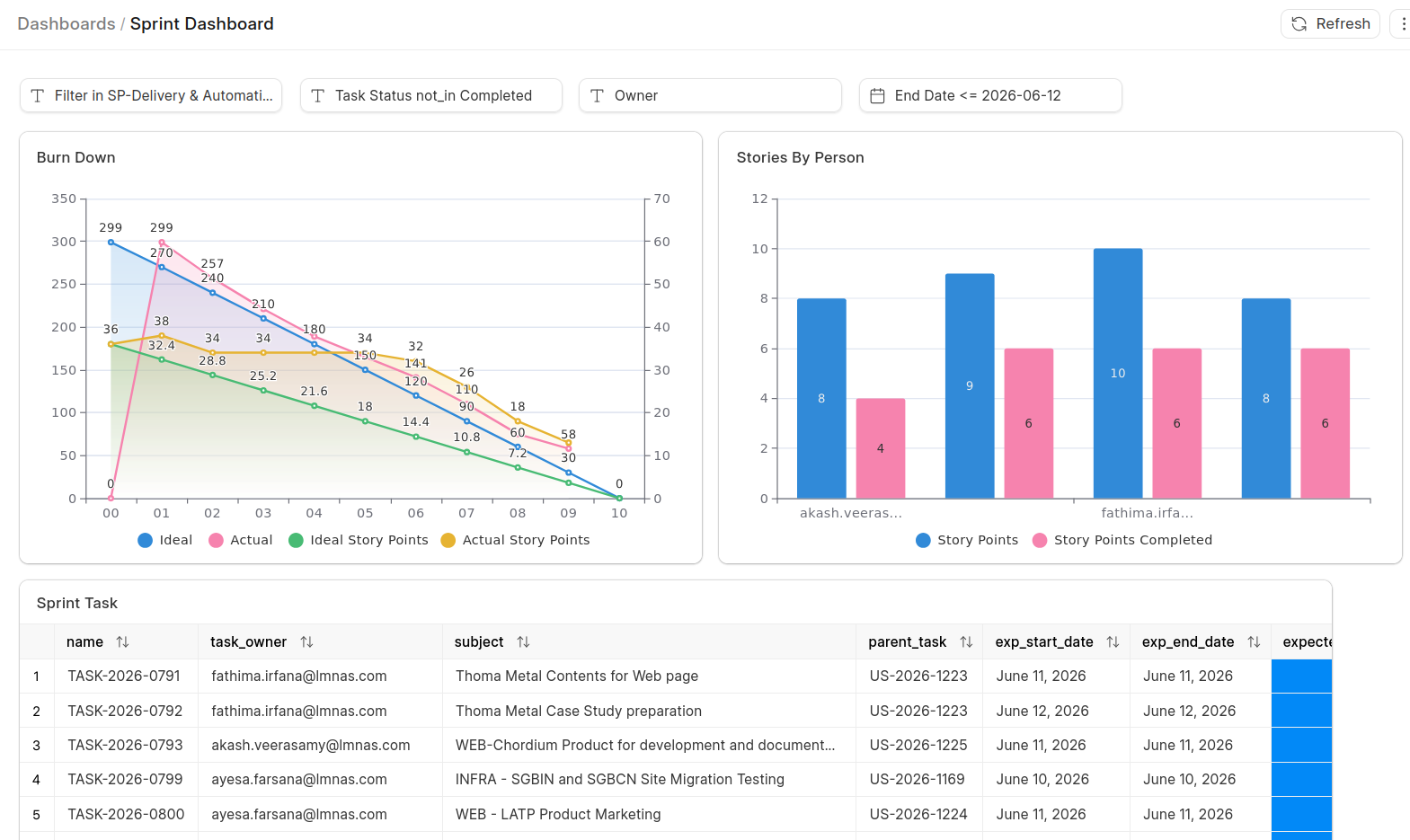
The dashboard becomes a daily decision-making tool, not a reporting tool.
Step 6: Measure Balance to Go (BTG)
One of the most valuable indicators during execution is Balance to Go (BTG).
Balance to Go shows the exact effort still needed to complete sprint commitments—updated daily based on actual task completion.
Unlike burndown charts that only show "we completed X% of work," BTG tells you: "If current pace continues, we'll miss by 12 hours and need mitigation." It's the difference between observing failure and preventing it.
BTG helps teams understand:
- Remaining workload (real, not estimated)
- Available capacity remaining (accounting for blockers and interruptions)
- Delivery risk (quantified)
- Completion likelihood (based on current trajectory)
- Areas requiring immediate intervention
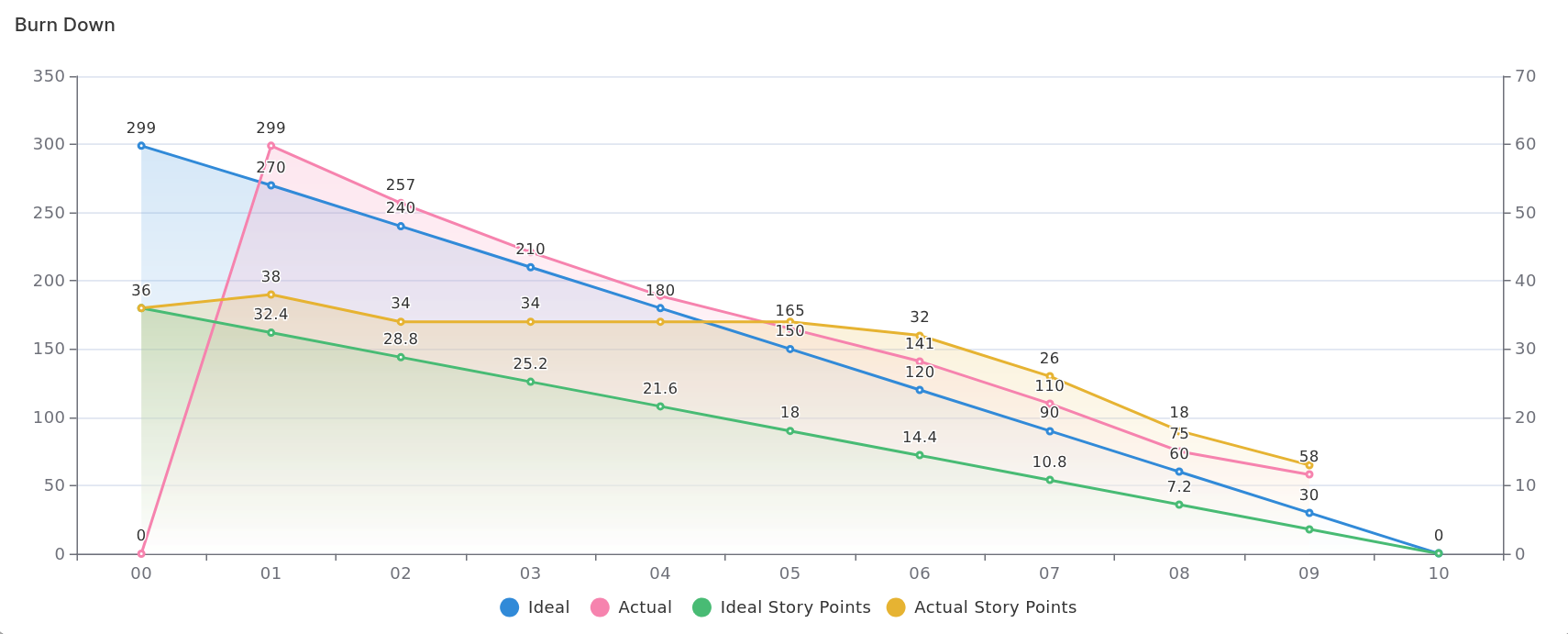
Teams can proactively manage delivery risk throughout the sprint instead of reacting to missed commitments on the last day.
Step 7: Track Progress Through Delivery Analytics
LENS IPS continuously captures execution data automatically—no manual status updates required.
Visual dashboards show:
- Day-by-day task and story completion (charted by individual team member)
- Individual contribution visibility (no hidden bottlenecks or uneven workload)
- Sprint health trends (velocity, BTG trajectory, risk indicators)
- Overall sprint performance (completion rate, quality metrics, cycle time)
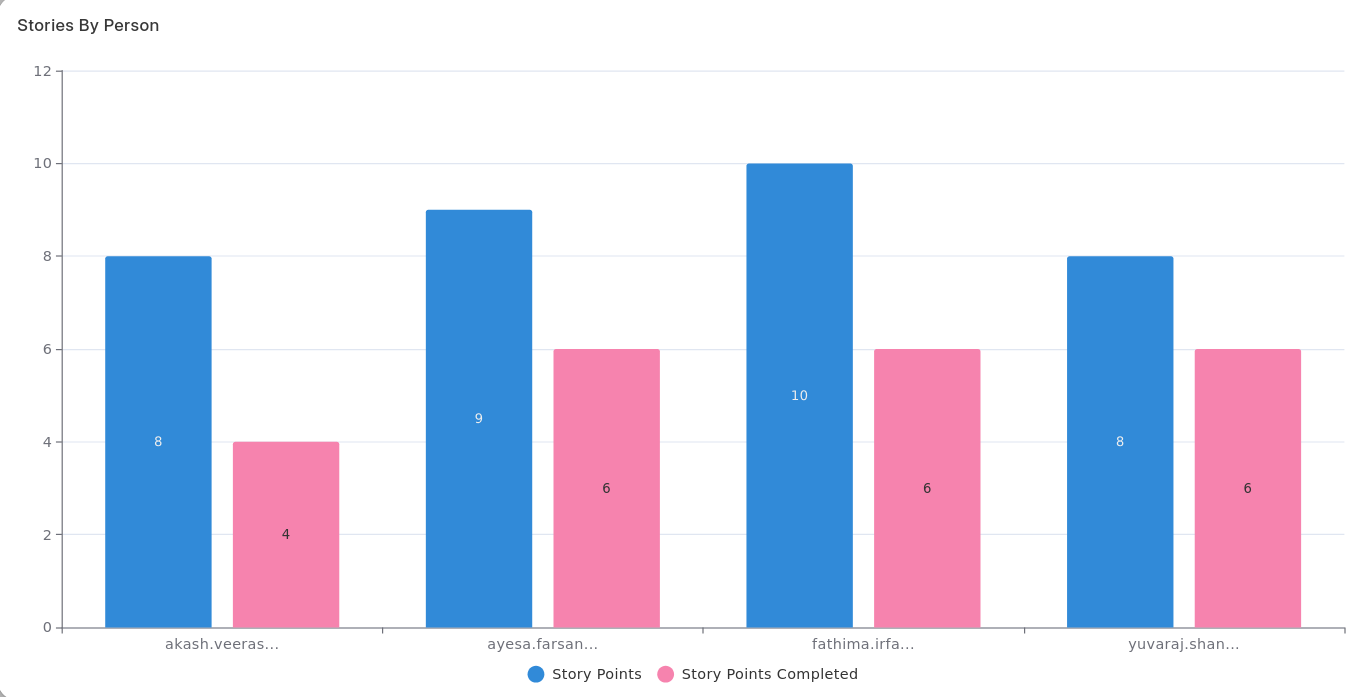
This creates transparency across the entire delivery lifecycle. Planning assumptions aren't just theoretical—they're continuously validated against execution reality.
Keeping Planning Connected
The objective is not simply to track work.
The objective is to ensure that changes in execution immediately influence planning decisions.
When capacity changes, plans adapt. When dependencies slip, risks become visible. When production issues consume effort, future commitments can be adjusted. This continuous feedback loop keeps forecasting, planning, execution, and delivery connected throughout the lifecycle—not isolated in separate silos.
Why LENS IPS Is Different From Sprint Boards
Most tools (Jira, Azure DevOps, Monday.com) are task trackers—they show what's being done, but not whether it's realistic.
LENS IPS is an integrated planning system. It connects:
- Capacity forecasting (What can the team realistically deliver based on actual capacity and velocity?)
- Demand planning (What should we commit to given available capacity and priorities?)
- Ownership-based scheduling (Plan My Story—team members schedule their own work, not managers imposing assignments)
- Execution visibility (What's actually happening vs. the locked plan?)
- Continuous adaptation (How do we adjust proactively when reality deviates?)
This closed-loop approach is why teams see measurable improvements:
- Reduced sprint spillover and carry-forward work
- Improved sprint commitment reliability
- Better workload distribution across team members
- Increased visibility into delivery risks before they become crises
- More proactive mitigation of delivery issues
- Improved focus on quality and engineering hygiene
- Reduced last-minute delivery pressure and team burnout
- Greater confidence in planning and forecasting
Other tools show work in progress. LENS IPS shows whether the plan will actually survive execution.
Outcomes
The improvements were not immediate, but the cumulative impact became visible over successive planning cycles.
By adopting a capacity-driven planning approach, improving visibility, and establishing stronger ownership through Plan My Story and locked commitments, the team achieved:
- Reduced sprint spillovers and carry-forward work
- Improved commitment reliability (moving from ~68% to 94%+ sprint completion)
- Better workload distribution across team members
- Increased visibility into delivery risks and bottlenecks before they escalate
- More proactive mitigation of delivery issues
- Improved focus on quality and engineering hygiene
- Reduced last-minute delivery pressure and team burnout
- Greater confidence in planning and forecasting across all stakeholders
Most importantly, delivery commitments gradually became more predictable, allowing stakeholders to make business decisions with greater confidence and improving overall delivery effectiveness.
Transform Planning Into Predictable Delivery
What began as an effort to improve sprint predictability revealed a broader truth.
Organizations do not struggle because they lack effort, talent, or commitment. They struggle because planning stages operate in isolation—capacity planning disconnected from demand planning, execution disconnected from the original plan, and no feedback loop to adapt when reality deviates.
This is true whether you're a manufacturing operation or an IT organization.
LENS IPS helps organizations connect forecasting, demand planning, resource planning, execution, and delivery into a unified planning ecosystem.
Whether your organization is a manufacturing operation balancing production demand with resource constraints, or an IT organization struggling with sprint spillovers and unpredictable delivery—the fundamental need is the same: keep planning connected to execution.
If your teams face any of these challenges:
- Recurring sprint spillovers and carry-forward work
- Planning uncertainty and missed commitments
- Resource constraints discovered too late
- Limited visibility into delivery risks until it's too late to recover
- Uneven workload distribution and team burnout from last-minute rushes
It may be time to rethink how commitments are planned and managed.
Book a 15-minute capacity planning walkthrough →
See how your team can move from unpredictable delivery to locked sprint commitments in as little as 2-3 planning cycles.